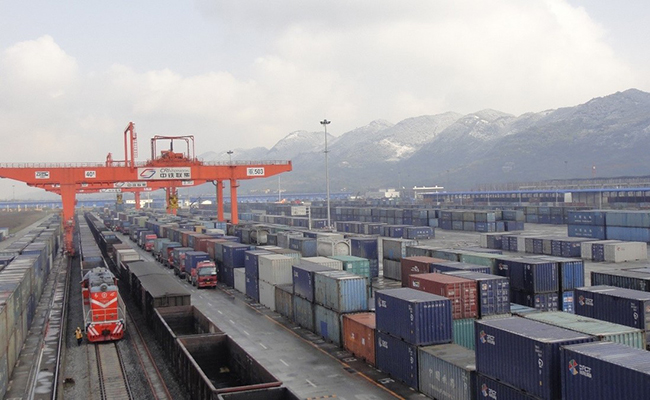
Container transportation instructions:
Container transportation involves packing a wide variety of general cargo into standardized containers with uniform dimensions of length, width, and height for transportation. These containers can be loaded onto ships for waterway transportation, or transported via rail or road. The goods do not need to be unloaded during transportation by changing vehicles or ships, which can enhance loading and unloading efficiency, facilitate mechanized operations, eliminate heavy manual labor, reduce cargo loss, simplify complex procedures, accelerate vehicle and ship turnover, and lower transportation costs. Additionally, container transportation allows for direct delivery from the shipper's warehouse to the consignee's warehouse, eliminating the need for transit warehouses and providing "door-to-door" transportation services.
Container transportation first emerged in the United States and was popularized worldwide in the late 1960s. In recent years, container transportation in China has also developed rapidly. Container terminals have been established in ports such as Dalian, Tianjin, Qingdao, Shanghai, and Huangpu in Guangzhou, enhancing the throughput capacity and modernization of these ports.
Container transportation utilizes specialized cargo containers (typically general cargo containers) for door-to-door combined transportation via sea, river, railway, and highway. It is a modern transportation mode with strong material equipment foundation and advanced technology. It implements mechanization, standardization, serialization, and specialization throughout the entire process of loading, unloading, transportation, and transshipment. Container transportation was first officially operated between European roads and railways in 1926, and later developed into international container intermodal transportation with ports and maritime transportation as the core. Currently, it is one of the fastest-growing and most widely used transportation modes in the world. It plays an important role and has significant effects in ensuring cargo safety, saving packaging materials, simplifying packaging and cargo handling procedures, improving transportation efficiency, accelerating cargo transportation, reducing transportation costs, and improving working conditions in transportation.